1A Goodsons Mews, Wellington Street, Thame, OX9 3BX

Can’t find what you’re looking for?
Get in touch today.
Popular Search Terms
Dairy
Llandyrnog has invested more than £3 million in the creamery since 2004. As part of the improvement programme, they reviewed their total raw milk storage arrangements and decided that the CIP operation needed upgrading.
On the Llandyrnog site, raw milk is stored in six 160,000 litre capacity silos which are cleaned on a daily basis. The Creamery’s CIP (Cleaning In Place) routine involved:
This was followed by the final rinse using fresh water.
All told, this cleaning routine consumed 400,000 litres of water every day drawn from the Creamery’s own bore holes.;
The CIP routine was originally devised for fixed spray balls installed at the same time as the raw milk silos – in 1974. They would deluge the interior walls with large volumes of water, and according to Brian Emmerson, Llandyrnog’s Chief Engineer, “They were nowhere near as efficient as we wanted and quite wasteful of water and energy.”
As well as being water and energy intensive, shadowing would occur in areas where the water failed to dislodge accumulated product. It also put a strain on the CIP system’s pump, making it necessary to stop and start between cleaning stages.

Reduce Shadows and Strains

Reduce Water & Energy Waste
They initially tested one Alfa Laval Sani Mega rotary head and achieved such excellent results that they quickly installed the same equipment in the remaining five silos.
Unlike the flooding action of spray balls, Alfa Laval’s Sani Megas clean through impingement and high levels of turbulence to a predetermined pattern. They scrub the silo’s internal walls with fan shaped jets that produce a vortex action once they reach the bottom outlet. The cleaning medium itself is used to drive an internal turbine and gear system at low speeds (5 rpm) which enables the cleaning process to be controlled with great accuracy
According to Brian Emmerson, Llandyrnog Creamery was able to reach optimum cleaning efficiency very rapidly once they had the Sani Megas properly set up. “Once the system was correctly configured we saw a difference. For a start, we noticed that the pre-rinse phase went from opaque to clear running much quicker than before, indicating that we were using much less water. Then, the same happened with the caustic phase and the intermediate rinse and so on. Basically it was a cumulative process with a good reduction in chemicals and water at each phase of the CIP cycle that resulted in less energy and water usage and greater cleaning efficiency.”
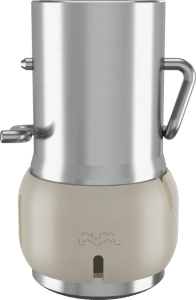
The Sani Megas have saved sufficient energy, time and water to quickly pay back the original investment.